
Congee
Congee: A Gentle, Nourishing Bowl
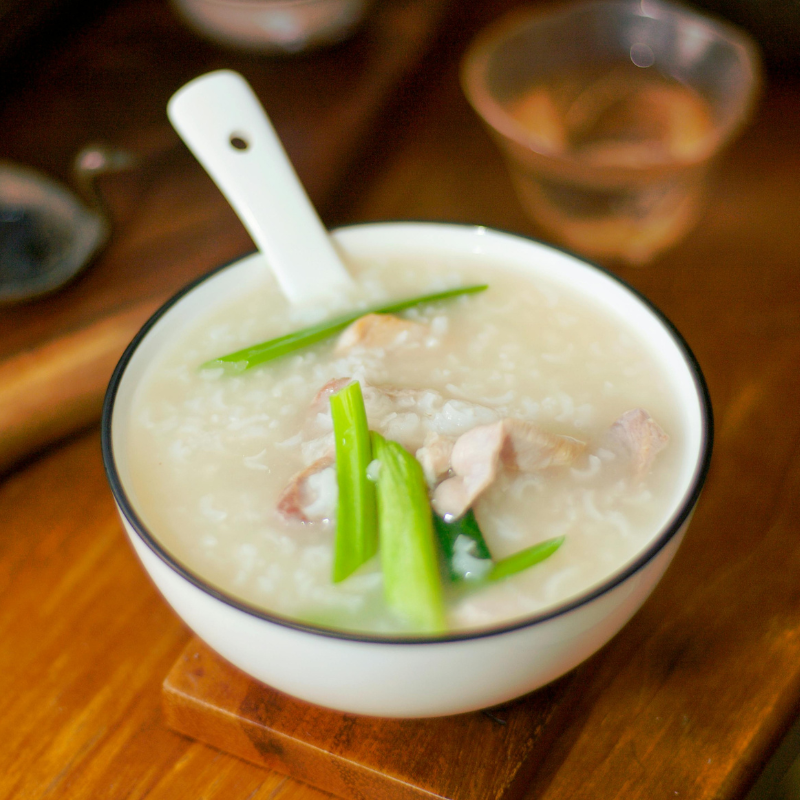
Congee: plain rice simmered slowly in plenty of water until it breaks down into a soft porridge, is one of the oldest everyday dishes in Chinese food culture. Eaten for breakfast, during convalescence, or simply as a gentle meal, it is the quiet foundation of the Chinese home kitchen.
1 hour 10 minutes
Total time
2 - 3 bowls
Serves
Warming
Neutral to gently warming
All year
Best season
The Traditional Chinese Medicine Perspective
In Chinese dietary tradition, congee (zhou, 粥) holds a special place as everyday nourishment. Classical dietary texts describe plain rice congee as neutral and gentle — a food considered easy to digest and suitable at almost any time of life. It has been eaten for breakfast across China for well over a thousand years, and it remains the standard home-cooked meal during recovery from ordinary illness.
The traditional logic is simple: long, slow cooking breaks the rice down completely, producing a soft, warm dish that requires little effort to eat. In traditional dietary theory, warm cooked foods are described as the default choice for everyday eating, with cold and raw foods eaten more sparingly — particularly in cooler weather.
Congee is also a base rather than a finished dish. Ginger, spring onion, mushrooms, chicken, egg, leafy greens or sweet red dates can all be added, shifting the flavour and the traditional classification of the bowl. The plain version below is the starting point — the toppings are where each household makes it their own.
As with everything in this recipe collection, warming, cooling and neutral are traditional descriptive categories from Chinese dietary texts — a framework for seasonal home cooking, not claims about physiological effects. Congee is everyday food, not a treatment.
Ingredient Notes
White rice
Ordinary short or medium grain rice breaks down best. Jasmine rice gives a fragrant bowl; sushi rice gives a thicker, creamier texture. No rinsing is strictly necessary, though a quick rinse removes surface starch.
Water or light stock
A ratio of about 1 part rice to 8–10 parts liquid gives a classic loose congee. Use water for the plainest version, or a light homemade stock for more depth.
Fresh ginger
Described as warming and aromatic in classical dietary texts. A few slices simmered with the rice give the whole bowl a gentle warmth.
Spring onion
The classic finishing garnish, added fresh at the table. In traditional terms it is described as pungent and warming — here it simply adds brightness and bite.
Sesame oil and white pepper
A few drops of sesame oil and a pinch of white pepper are the traditional finishing touches, stirred through just before serving.
👨🍳 The Recipe
🍴Ingredients
- ½ cup (about 100 g) white rice — short or medium grain works best
- 1.2 litres water or light homemade stock (roughly 1 part rice to 10 parts liquid)
- 3–4 thin slices of fresh ginger
- 2 spring onions, finely sliced, to serve
- A few drops of sesame oil, to serve
- A pinch of white pepper, to serve
- Sea salt, to taste
Method
1 Rinse the rice
Rinse the rice briefly under cold water and drain. This removes surface starch and keeps the finished congee silky rather than gluey.
2 Simmer low and slow
Add the rice, liquid and ginger slices to a heavy-based pot. Bring to a gentle boil, then reduce to the lowest simmer. Partially cover and cook for 60–75 minutes, stirring occasionally to prevent sticking.
3 Break down the grains
The congee is ready when the rice grains have burst and the mixture is thick, creamy and porridge-like. Stir more frequently in the last 15 minutes. Add more hot water if you prefer a thinner consistency.
4 Season and serve
Remove the ginger slices, season lightly with sea salt, and ladle into warm bowls. Top with spring onion, a few drops of sesame oil and a pinch of white pepper. Serve hot.
- Overnight shortcut: soak the rice in water overnight — it breaks down in around 30 minutes of simmering.
- Slow cooker method: cook on low for 6–8 hours with the same ratio; stir well before serving.
- Classic additions: a poached egg stirred through, shredded poached chicken, sliced mushrooms, or a handful of leafy greens wilted in at the end.
- For a plain convalescent-style bowl, skip the stock and seasonings — just rice, water and ginger.
- Congee thickens as it sits. Leftovers reheat well with a splash of water stirred through.
Frequently Asked Questions
Is Congee a treatment for any health condition?
Why is congee eaten during recovery from illness in Chinese culture?
It is a long-standing cultural custom: plain congee is soft, warm and easy to eat, which makes it a practical food when appetite is low. This is a household tradition, not a therapeutic claim — anyone who is unwell should follow the advice of their GP or treating health professional.
What does 'neutral to gently warming' mean?
Warming, cooling and neutral are traditional descriptive categories used in Chinese dietary texts to guide seasonal home cooking. Plain rice is described as neutral, and ginger as warming. These categories are not measurements of temperature and are not claims about physiological effects.
What is the right rice-to-water ratio?
About 1 part rice to 8–10 parts liquid is the classic loose congee. Use 6 parts for a thicker, creamier bowl or up to 12 parts for a thin, drinkable consistency. Ratios are flexible — add hot water at any stage to thin it down.
Can I make congee with brown rice?
Yes, though brown rice stays firmer and needs longer cooking — around 90 minutes to 2 hours. The result is nuttier and less silky than white rice congee. Soaking the brown rice overnight helps it break down.
⚠️ This recipe is shared as general information drawn from Chinese dietary tradition. It is everyday food, not a treatment for any health condition, and it is not a substitute for advice from your GP, dietitian or other registered health professional. If you are pregnant, managing a diagnosed condition, or taking prescribed medication, speak with your treating practitioner before making dietary changes.
Continue Exploring
More TCM Recipes
Browse the full seasonal recipe collection.
Traditional Chinese Medicine
An integrated, whole-person approach to your health and wellbeing
Chinese Herbal Medicine
Individualised herbal formulas prescribed alongside your treatments.
Acupuncture
Precise, personalised acupuncture as part of your TCM treatment plan.
Find Us
Visit our Traditional Chinese Medicine clinic in Georgetown, Newcastle
Mayfield, Waratah, Hamilton, Lambton, Jesmond, New Lambton and the wider Hunter region.

On Point Natural Medicine
Acupuncture Clinic
Address: 57 Georgetown Rd, Georgetown NSW 2298
Phone: 0494 325 886
Website: onpointnaturalmedicine.com.au
Opening Hours
- Monday: 8:00 am – 4:00 pm
- Tuesday: 9:30 am – 7:00 pm
- Wednesday: Closed
- Thursday: 9:30 am – 7:00 pm
- Friday: 8:30 am – 4:00 pm
- Saturday: Closed
- Sunday: Closed
-
*Hours may differ on public holidays.
Curious About Dietary Guidance?
Dietary advice tailored to your circumstances is discussed during a consultation. Book online or call the clinic to arrange a time.